
Design leadership is being redefined in real time.
These articles are for design leaders who want to think harder about the profession, not just keep up with it. No generic frameworks or management models, but real-world insights into how the profession is being reshaped by AI, organizational complexity, and rising expectations.

Burnout
Today there are more reasons than ever to feel burnout, the issues we are facing are both global and personal. With higher degrees of fragmentation and a widening gap in our ability to sustain a community, even amongst close friends and colleagues. If you are feeling burnout from work, its important to step back and assess. To find the ability to reflect and understand what is triggering the burnout before taking action to correct it.

Curiosity, courage, challenge
“You’re like an untrained LLM”. Does today’s social network/AI generation have enough individualized knowledge in their heads, enough experiences, stories, inspirations internally with which to model their response to the world? Creativity requires curiosity, courage and challenge. It also requires patience, which we seem to be loosing more and more of everyday. With social media and on-line games being their primary means of socialization, can this generation’s understanding of the world help but be small and insulated? Will they be curious and courageous in the face of challenges, or will they simply watch it unfold on their little screens?

Candidates, its not your fault
Hiring teams and recruiters owe candidates accountability, not excuses. Ghosting is a natural byproduct of an immature hiring process. Whether your not you rejected a candidate because your team botched an interview, or the person was legitimately not a fit, own it. Reach out. Make your decision clear. Candidates deserve respect, not be to collateral damage from someone else's unpreparedness.

Innovation has three faces
Most "innovation" is incremental noise chasing technology or profit. It’s a reflexive enhancement or a copy of a competitor's move. Engineers build to demonstrate what new technology can do. Business spends the minimal capital needed for the most revenue possible. Design starts somewhere else: with people. To be sure, design will leverage the latest tech, and work to get highest ROI, but only after it can answer the one question that produces something worth having.

Four Sub-Strategies
A common complaint amongst design professionals is that design is seen as a verb,—something you do, and not as professional discipline. Now with AI, the verb design can be done by anyone who has access to a design system and ADA guidelines. Design needs to take ownership of the word design—like engineering, marketing and (product) management have done. More importantly design needs to regain the trust that it has lost in the last 20 years.
Concerning interests
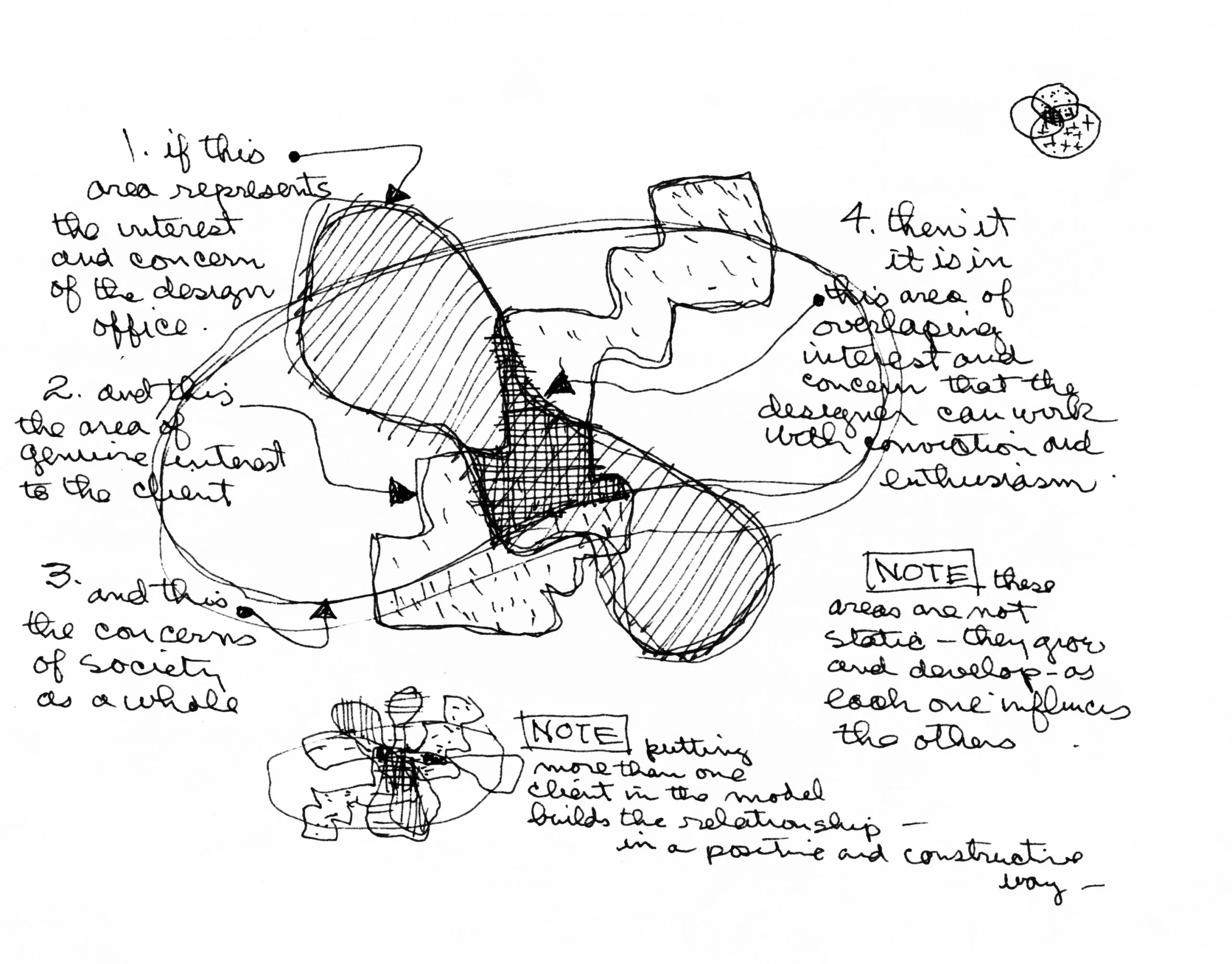
While I am not tone-deaf to our current economic landscape, I am also aware that many designers, especially UX designers, are feeling disenfranchised, drifting in the long shadow AI is casting over their perceived self-worth. In response I cannot help but ask: do you know what truly interests you, what concerns you, as a designer? And are you working in pursuit of those interests? Or are you just working?

Scaling for AI
AI is repeating design's mistake: throwing budget at tools without building the skills to use them. Twenty years ago companies threw headcount and budget behind design without understanding what made it actually work, and the results were disappointing to everyone. Today companies doing the same with AI: near-universal adoption, blown budgets, almost no enterprise-wide value. The fix isn't more spend or a better model. It's building the coaching infrastructure to use AI well. Here's what SAP's design transformation teaches us.

Get on the plane…
how do you make the leap from IC to executive? No two paths are ever the same. Sometimes it a question of hard work, taking one step at time. Other times its a question of getting on a plane.

Detoxing
Changing roles is a great time to detox from the culture you just left. While the experience you gained at your previous company is likely a big part of what gets you hired into your next role, it's worth taking time to be intentional about what you want to bring with you. While you're looking for your next role, do the work to separate what is authentically you from the habits and assumptions you've picked up along the way.

Making is a prerequisite for designing
Craft is not a credential. Unfortunately most design leaders have reduced making to things like post-it notes and white board sketches. Or assembling components from pattern library like Colorforms. Design leaders who have never made something from raw material, never felt the gap between their intention and the execution created by their own hand, can never really understand craft.

Fear is the mind killer.
As Frank Herbert said: “fear is the mind killer”. But today’s is the fear of missing out. AI is causing companies to revert to old behaviors; chasing the technology and not the opportunity. You can’t talk your way into alignment, no mater how many presentations or white papers you write. For design leaders the most effective way to advocate for your point of view it to put it into action, to demonstrate why it matters.

From Imagination to Accountability
Designers have dedicated two decades to mastering the language of business, but most stopped there. They stopped short of true impact. Were you one of them?
Despite acquiring the right vocabulary, these designers often express frustration over their perceived lack of authority. The issue is not in what they say; its what they hold themselves accountable for. Accountability for what gets built and why, its effectiveness, and its impact on growth. Designers who bridge this gap be asking for a seat at the table; they will have build their own.

AI doesn’t want your design job, really, it said so.
Eliminating you design team while potentially making the numbers work in the short-term will have a negative impact almost immediately. AI identified 5 key areas where it cannot do the designer’s job, so your engineers will need to step up if you want to deliver success.

Value of Meaningfulness
Design is not aesthetics. Design is solving meaningful problems in meaningful ways. Design distills what has meaning to the user, both in the near-term as well as the long-term. Design serves the betterment of society using the tools of the time. And it strives to understand what has meaning to our civilization ensuring both equity and inclusion. Design strives to find meaningful solutions beyond humanity’s constructions to address planetary concerns ensuring sustainability and regeneration. Design’s responsibility is to go beyond mere emotion and to provide people with the ability to assign meaning beyond functionality.

M is the new T
For decades, we have all tried to hire T-shaped talent: people with broad general knowledge and deep expertise in a single discipline. It made perfect sense when roles & deliverables were clearly defined but AI has rewritten the rules. Today, the boundaries between design, engineering, product, and marketing are dissolving. Work no longer happens within disciplines. Innovation emerges from people who can connect ideas, evaluate AI-generated outputs, and understand the underlying models and data that shape them. The future belongs to M-shaped professionals.

The CEO Crush: Why Design’s Obsession Misses the Point
Simply pushing for design to report to the CEO is like teaching a pig to sing: it wastes your time and annoys the pig. Stop demanding to report to the CEO and start delivering value to the business in dramatic and game changing ways. Demand accountability for the success of the business; meet with customers, turn their needs in revenue—both new and recurring. Stop leaning back, expecting to be noticed and lean-in, engage, build value both for the company and for yourself.

Processes & Playbooks: the modern take on Procrustes
Blindly applying a prescriptive playbook or process to every novel situation will deliver predictable outcomes but it will also ensure the outcomes are mediocre at best, and worst leave untold value sitting on the floor. Don’t allow the rush to conformity rob you of innovations, or the ability to gain greater value, simply because it was hanging over the foot of your bed.

Credibility is not negotiable
No Baker, Doctor, or Mathematician ever felt their profession was at risk because of a boxed cake mix, first aid kit, or a handheld calculator. Consumers want designs that engage and connect on an emotional level; they want designs that feel intuitive, personal, and that make them felt seen. The first university programs for Human Computer Interaction were established over 40 years ago. The science of ergonomics and human factors goes back to the 1940’s. Design should never be negotiated the way priorities are debated. Designers need to stand up for their own creditability if they expect others to do the same.

Craft is a mirage
Craft, as we invoke it today, is an illusion—a nostalgic callback to a halcyon era of design when form, color, texture, refinement, and detail were shaped through apprenticeship and accumulated over decades. The uncomfortable truth is that the ground beneath the profession is shifting faster than most can adapt. But in a era where trends ignite and evaporate at the speed of an algorithmic swipe, craft is a mirage, promises of stability, control and relevance in a world defined by volatility.

Innovation
In the game of Battleship, knowing where your opponent’s ships are not is as important as knowing where they are. The same is true with product development: knowing where not to invest gives you focus and dramatically increases your odds of winning the game. Knowing where the battleships are not is also true for companies pursuing strong lines of growth and market position. Knowing what the market is ready for, who’s investing to define the space, creating awareness, and priming the pump is critical. While first mover advantage is the dream of many entrepreneurs, second mover advantage reduces your risk, and allow you to invest in building a better moat: superior execution.