
For too long the design profession has had a DINO problem; Designer in Name Only. Unfortunately, its a problem the profession created for itself.
Twenty years ago, there was a high demand for designers, so members of the profession seeing an opportunity created bootcamps, which were basically a set of overly simplistic design projects and a stack of derivative how-to books, all delivered in the promise that in just 6–12 weeks you’d be a designer.
It was horseshit then and its horseshit now.
Camp Wa’Namaka Mohnee
The books were often written by the person delivering the bootcamp and were nothing more than a collection of sound bites distilled from legitimate and admittedly complex academic texts. The books were derivative and superficial at best—their authors often lacked the academic training necessary to understand, let alone apply, the original theories. Taking a reductionist approach, they presented design as a set of simple aphorisms. They stripped complex theories of cognition, learning, and perception down to a set of spoon-fed dos and don’ts. They removed the foundational understandings behind human-centered design and focused simply on appearance and layout.
Given that these authors lacked any actual expertise or competence in the domain knowledge and science behind the design of complex human-computer systems, and the courses were constrained to a few weeks, the bootcamps lacked any legitimate pedagogy. The individuals who emerged from them were DINOs: Designers In Name Only. Today the vast majority of people holding design positions are unfortunately DINOs have completed superficial design programs.
Design education is no different from computer science or business management or electrical engineering. Design has a long academic history, with extensive research, theories, formal and informal principles, systems frameworks, and yes, skills that are learned and refined over time, leading to the acquisition of judgment and taste. Design pedagogies have been evolving for over 100 years across thousands of academic institutions.
When applied to the creation of complex human-computer systems, that disciplinary knowledge needs to be merged with the knowledge of other disciplines such as cognitive psychology, computer science, systems engineering, etc., in order to effectively know how individuals will interact with, learn, control, and troubleshoot complex systems that are abstracted and symbolically represented on a display and manipulated with keyboards and a mouse—or now with voice and prompts fed into a non-deterministic system.
Design Systems as Scripture
For DINOs, design systems are oxygen. Without them, they don’t stand a chance. DINOs tend to love design systems to the point of obsession. I believe that is because they have nothing else to hold on to. They lack the actual domain knowledge to design without their “Colorforms.”
Design systems have existed for 70+ years. Throughout that time, they have been used in industrial design, graphic design, and retail design to reduce time to market, decrease costs, and improve quality. From the original work at Xerox, design systems have been used in digital products for the same reasons.
In the same way dictionaries scale consistency, not literature, design systems don’t scale design.
But for most of that time, they have been used as the starting point in the design, not the measuring stick. That is because, until DINOs, formally trained designers used design systems (or, as they were sometimes known, design languages) to inspire innovation: to break the system just enough to create differentiation and novelty while still maintaining familiarity.
In the same way dictionaries scale consistency, not literature, design systems don’t scale design; they only make the designs themselves consistent. (Which is not necessarily a good thing.) But for the last 15 years DINOs have been focused on building an governing design systems.
Its not surprising then that with the increased hiring of DINO’s, design systems have emerged as such a critical pillar in design organizations. For most organization’s things like craft, taste and judgement were given over to the design system. Unfortunately today AI makes it easy to roll these systems into the organizations generative toolkit.
Today, as AI is being used to replace people, designers are grasping at taste, judgement and craft like a drowning man grasping for a life preserver. Unfortunately, I don’t believe it’s going to save them. Don’t get me wrong, for designers craft, judgement and taste are critical skills that take years to develop and in my experience that starts with a formal design education. However, the very nature of bootcamps set-up DINO’s to rely on simplistic rules and design systems rather than developing their own taste, judgement, or craft. They have argued, often energetically, that consistency with the design system equals judgement. And that compliance to the design system’s rules ensures well crafted solutions. And that a comprehensive design system contains all the elements necessary to ensure the solutions are in fact tasteful (and on brand). Unfortunately, AI is far better at ingesting and applying design systems—and I mean all the design systems it can find, than a person.
When AI started to replace the DINOs, they were quick to rally behind the craft banner. AI’s craft has improved faster than the DINO’s were able to keep up. Now the DINO’s are claiming their taste and judgment are critical. But again, they have to refer to their design system to make that call, its just a matter of time before AI will outpace them on judgement and taste.
So what does that mean for design?
We are in the ugly phase of the AI revolution. The same thing happened in the Industrial Revolution—the race to make machines outpaced making them safe, easy to use, or focused on solving meaningful problems. It took a generation to turn mass produced into well designed. The same thing happened in the dot-com revolution. At first, every website was poorly designed and hard to navigate, and with things like blink tags and 16-bit images, they were just downright ugly. The same thing is happening with AI the only question is how long will its ugly phase last?
Craft, taste and judgement (about what’s good or bad design) are not going to save design. DINOs holding on to craft (i.e., design systems + taste) is extinction behavior.
Leadership will save design.
Designers need to grab AI and shape it into something that has value—something that solves meaningful problems in meaningful ways, even if that means not using AI either to create the solution or as part of it. Just the same way design took a wagon with an on-board, internal combustion engine and turned it it an automobile. Or a duplicating machine with exposed gears, chains, and printing plates, into a streamlined self-contained cabinet that worked to protect its user.
Leadership is the ability to inspire others to follow your vision. To demonstrate that vision’s impact. And to execute on it. Design needs its leaders to stop hiding behind craft, judgement an taste and step-up and actually lead.
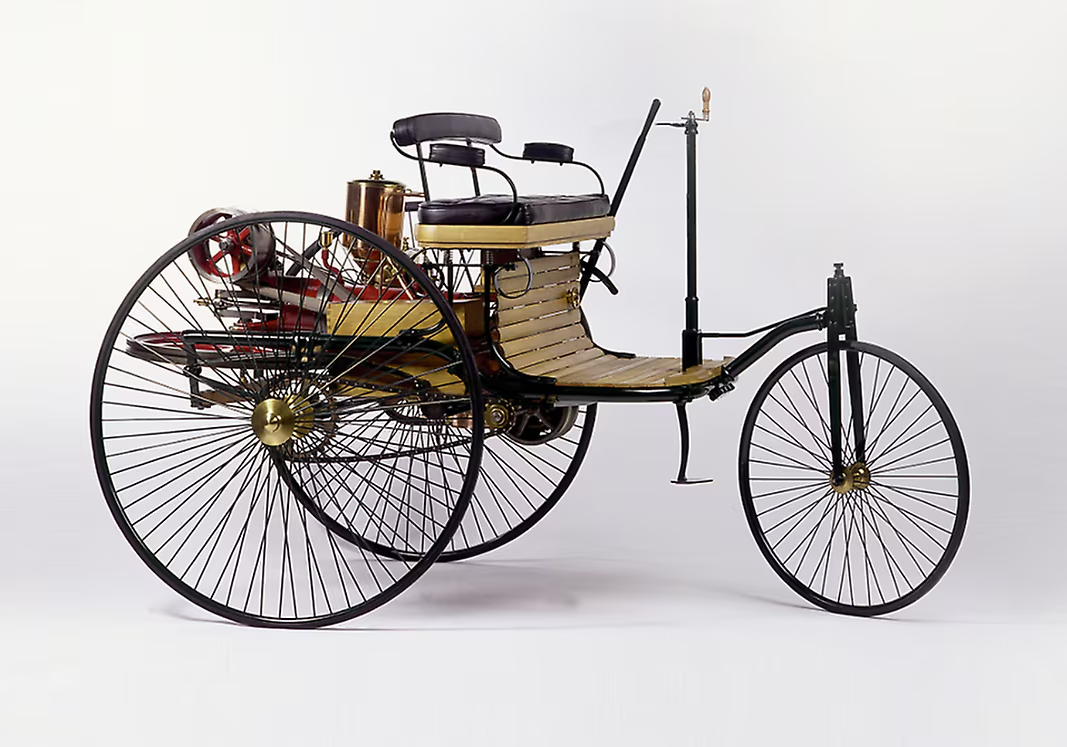
Orignal Benz Patent Motorcar 1886
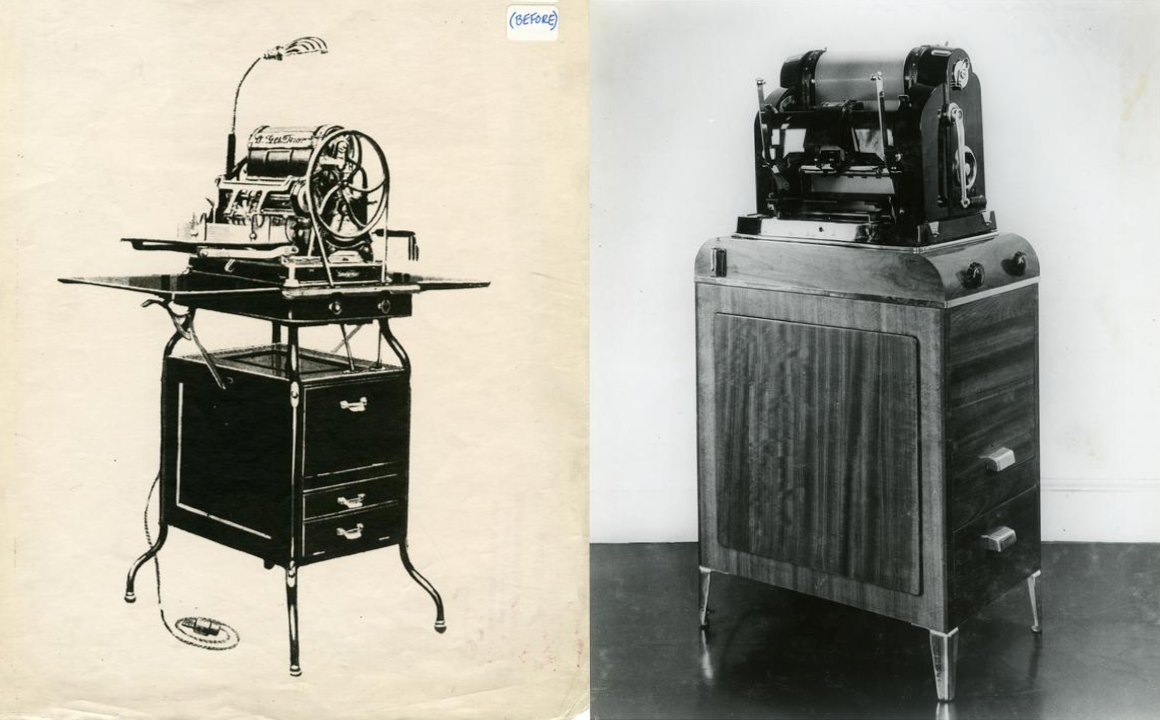
Gestetner duplicating machine before & after Raymond Loewy
