
Four Sub-Strategies
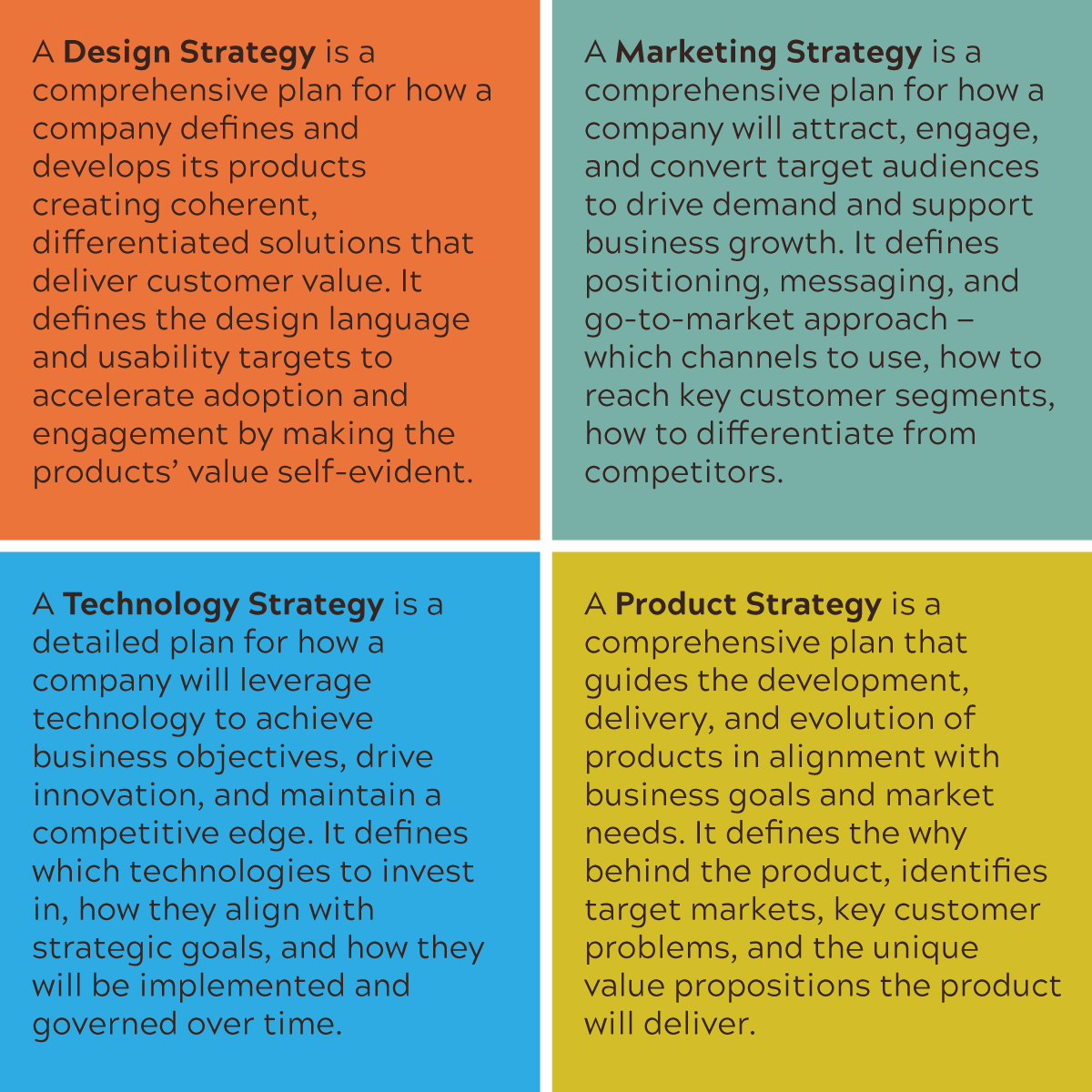
Within the software industry as part of the company’s strategy technology, product, and marketing will frequently develop internal strategies to align their teams to the company’s overarching strategy. This is done for both role clarity and to define ownership and accountability. While less frequent, design organizations may also craft an internal strategy. However more often than not, these design strategies focus on things like aesthetics, compliance to their design system, or adherence to accessibility standards. Unfortunately, those are tasks the CEO, let alone a BOD, have no interest in—they are “housekeeping” tasks, not a strategy.
If design wants to be peer to the other three core professions, it needs to up its game.
A common complaint amongst design professionals is that design is seen as a verb,—something you do, and not as professional discipline. Now with AI, the verb design can be done by anyone who has access to a design system and ADA guidelines.
The other three professional fields (technology, product management, and marketing) have long understood that what counts is the ability to deliver business value. They also understood their individual success is dependent on a shared, industry wide narrative—one that spans across companies and personal philosophies, that replaces the verb (engineering, managing, and marketing) with a profession.
You still can engineer a business deal, a social occasion, or a political campaign. You can always manage a meeting, a household budget, or a reservation. You can market a book, charity race, and there are still farmer’s markets, real estate markets, and stock markets. But the context of software companies, engineering, product management, and marketing have very specific professional connotations. Those verbs are professions. Design has never really owned the term “design” in the same way. And it has fallen far short of a shared cross-industry narrative that underscores what it means to be a professional designer.
Four Strategic Areas
Technology is probably the easiest of the four core area’s to define in terms of of its strategic impact. Software is at its core technology. Finding the right technology—whether built in-house or sourced from third parties is fundamental. Quickly followed by ensuring that technology is reliable, scalable, and secure.
Marketing is similar; its well understood in all but a few cases, products don’t sell themselves, so its necessary engage with the people who are likely to buy what you are building. Understanding what images and narratives will compel potential to go from listening to nodding their heads to making the purchase.
Product Management is the newest of the four, in the last two and half decades its gone from tracking development time tables to prioritizing target markets and customer issues, to having opinions on tech stacks, collateral, and the user experience. At its core however, the role of product is to track the performance of the product against the business goals.
Design has been around longer than the other three (P&G kicked off its “Brand Men” in 1931, Microsoft introduced product management in the 1990’s, “software engineering” was coined in 1968, but software engineering degrees didn’t show up until the 1990’s), yet design’s strategic value has been eroded and today is at best poorly articulated. Each design leader has had to define their discipline’s value on their own, with no shared reference for what a design strategy is. Let a shared knowledge base for articulating design’s value or measuring its impact.
Why this matters
Design tends to place big bets; game changing products that leapfrog the competition and redefine markets. Unfortunately, the big bets also represent big risks. Designers relied on their work to speak for itself and to assuage the risk. However the business wanted to see numbers; forecasting data, competitive performance, market segmentation and trend analysis. Design was put off by things like focus groups and surveys, pointing out their academic shortcomings inaccuracies, and their inabilities to capture paradigm shifts. However design also never offered any viable alternatives. The devil you know is better than the devil you don’t.
In the 1990’s Product Management emerged from program management, business analytics, and marketing, and unlike Design was content with making small steps in regards to innovations. Product Management has always been risk adverse and would take a more control approach. While individual Product Managers can be just as excited as designers by the potential of large scale paradigm shifts, the practice of product management is typically disinclined to take risks, recognizing its safer to take small steps forward than attempting giant leaps. Given they allow you to get to market faster, and in theory quickly iterate and course correct based on market response. While their long-term objective is the same as design’s, given their patience to move in small measured steps, they were able to leverage data to gain the trust of the organization. It arguably takes longer to achieve the same results, no one is required to take a leap of faith.
Today design is facing a new challenge, AI. Design needs to regain the organization’s trust. To do that it needs to have a clear, differentiated strategy that impacts the business, and its bottom line. This will also allow design to finally own its own name, and move from a verb to a profession in the eyes of the CEOs.
